Free Tourist guide in Belluno – Discover the selection of the best tour proposed by Belluno Tourism.
It is probably the first church of the Christian community of Belluno, built in the old roman burial ground outside the city wall, along the road – now via Rivizzola – leading to the old bridge over the Ardo river and to Cadore. It was located outside the ancient urban boundaries, so it probably is…
Tipical private building, well balanced as it shows the typical arcade palace with different windows sizes and forms, peculiar to the urban architectural pattern of Belluno. The little palace was built in 1595 by Giacomo Barpo, who in the next year succeeded in reintroducing his family into the noble city council. The building is the…
A palace erected in baroque style at the beginning of XVII century, assembling two or three older buildings. The construction was decided by the Cesa family, who owned an altar in the nearby church of Santo Stefano. Admitted in the noble city council in 1547 and extinguished in 1624, surviving in the Pagani-Cesa branch. The…
Well balanced Renaissance building, with a lowered arcade facing Via Roma, the old city quarter named after the church of St. Stephen. It offers the peculiar solution of a double stone balcony, with a decoration pattern that follows the model offered by the balconies of Palazzo dei Rettori. The lower balcony, with a pulpit-shaped basis,…
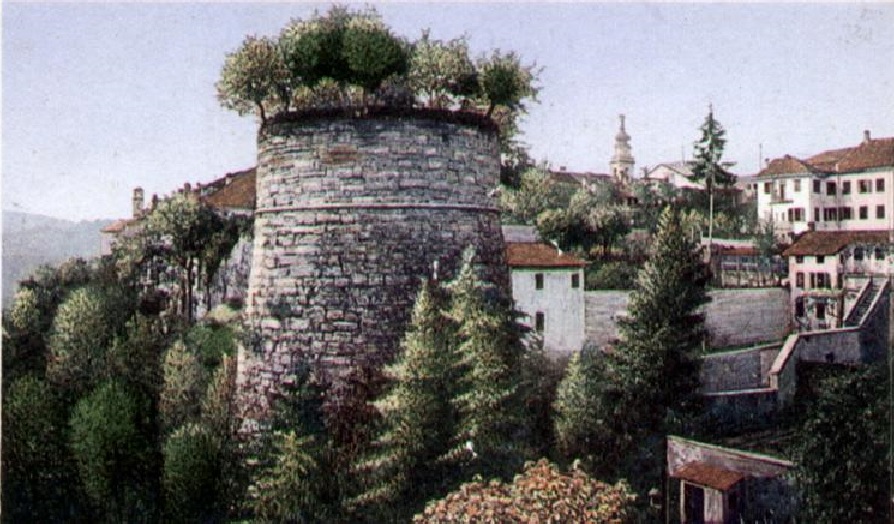
It is the only surviving element of the ancient city wall of Belluno, although it is closed by the modern buildings that during XIX and XX century have deeply modified the outlook of this part of town. It was built in early middle ages as the eastern corner tower of the city wall. Its ancient…
The gate got its name from the near corner tower of the city walls, called “Dojon” (which is the local middle age form of the english word “dungeon”), with whom it used to be part of a fortified system, for a short period also bishops castle, on the north-east corner of the ancient walls. The…
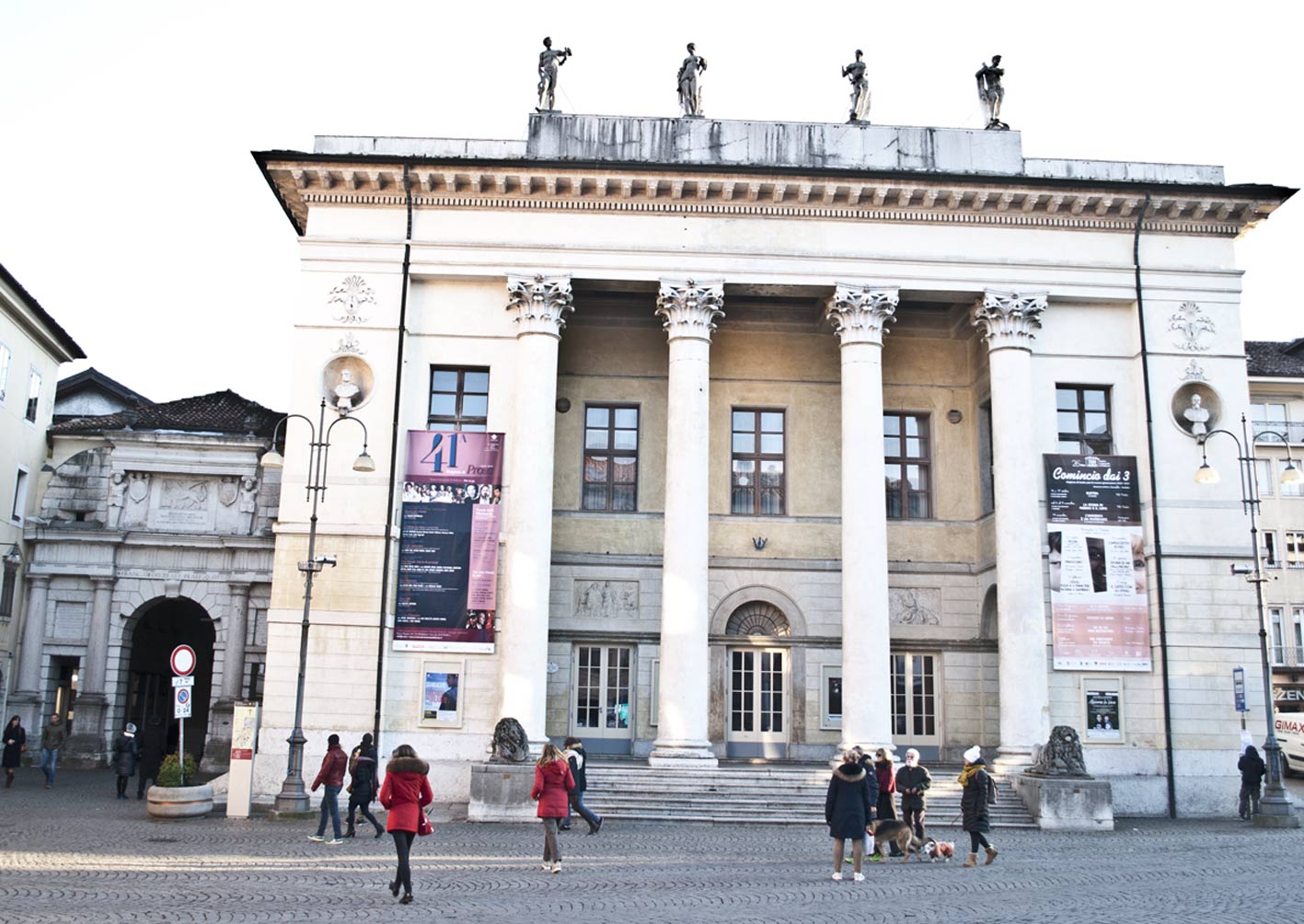
Neoclassical building designed by Giuseppe Segusini in 1833-35 on the place of the ancient city grains storage (there is a last piece, the old architrave, fixed to wall on the rear of the theatre), a much smaller building that used to exist beside Porta Dojona, leaning on the city wall . On the façade, similar…
Opened on May 15th 1865, at the end of fifty years of Austrian rule, as a patriotic symbol of the cultural unity of Italy although still divided at that time. Actually it was just a new dedication, since the bronze bust of Dante was placed on top of the older venetian Renier gate, built in…
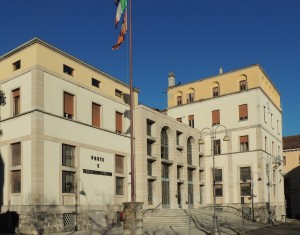
Built in 1936-38 following a project of the architect Alberto Alpago-Novello, it rose on the site where in the part thousand years there was the city castle, almost abandoned already during the last centuries of venetian rule and completely dismantled after 1806, when the city Jail was built on the same place, while the stones…
XVI century building erected by Nicolò Crepadoni assembling some older buildings (maybe the “altana” terrace still preserves the basis of one of the ancient towers, higher than the city wall). Part of the original frescoes can still be seen downstairs and at the first floor, in the reading room of Belluno’s Public Library. Inside, under…