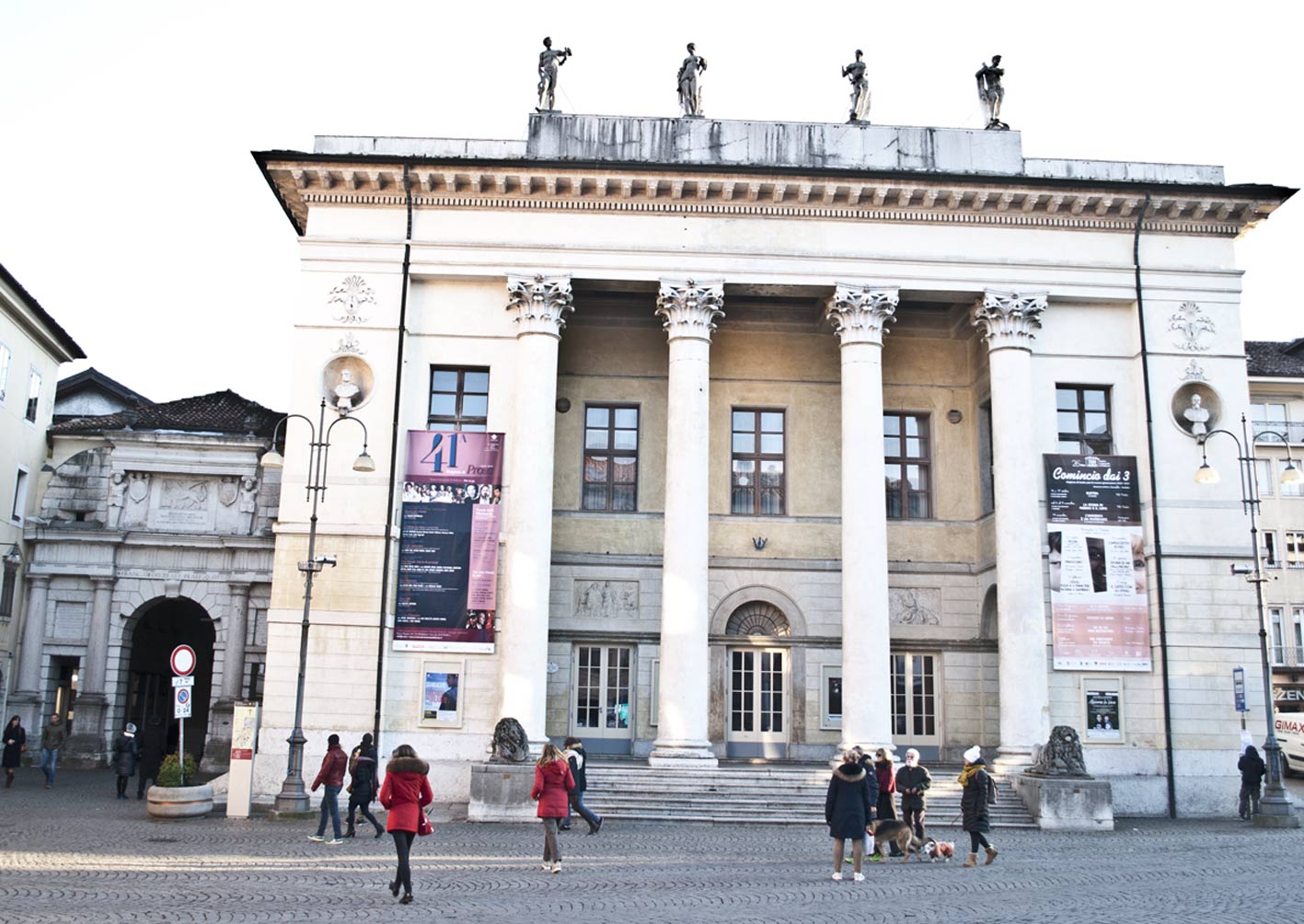
Municipal Theater

Neoclassical building designed by Giuseppe Segusini in 1833-35 on the place of the ancient city grains storage (there is a last piece, the old architrave, fixed to wall on the rear of the theatre), a much smaller building that used to exist beside Porta Dojona, leaning on the city wall . On the façade, similar…

Dante Gate

Opened on May 15th 1865, at the end of fifty years of Austrian rule, as a patriotic symbol of the cultural unity of Italy although still divided at that time. Actually it was just a new dedication, since the bronze bust of Dante was placed on top of the older venetian Renier gate, built in…

Post Office Building

Built in 1936-38 following a project of the architect Alberto Alpago-Novello, it rose on the site where in the part thousand years there was the city castle, almost abandoned already during the last centuries of venetian rule and completely dismantled after 1806, when the city Jail was built on the same place, while the stones…

Crepadona Carrera Palace

XVI century building erected by Nicolò Crepadoni assembling some older buildings (maybe the “altana” terrace still preserves the basis of one of the ancient towers, higher than the city wall). Part of the original frescoes can still be seen downstairs and at the first floor, in the reading room of Belluno’s Public Library. Inside, under…

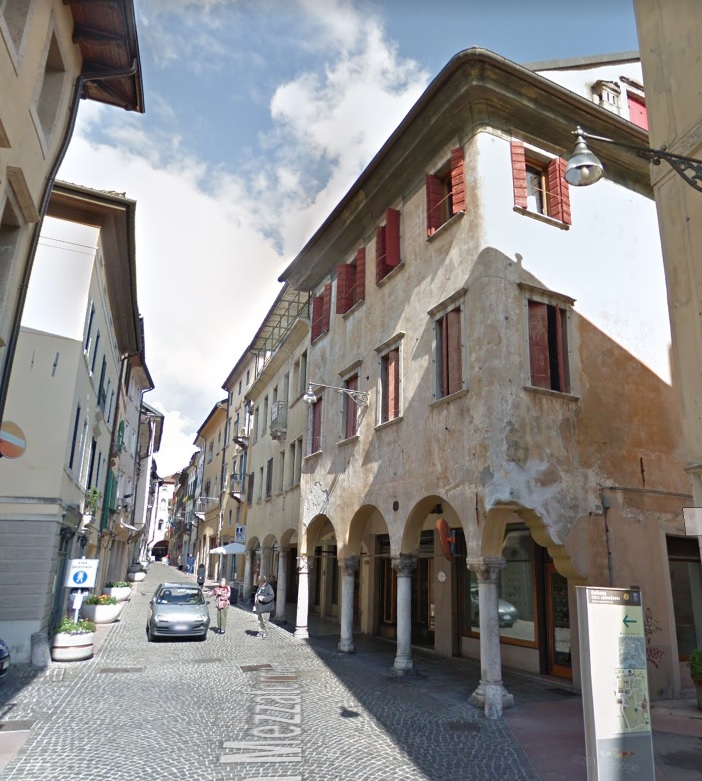
Miari Palace in herbs’ square

Typical XVI century building, with its structure with a high arcade on the ground floor and the double three-windows balcony on the upper floors. The façade, under the highest balcony, still preserves some fragments of the original fresco decorations, partly repainted by Giovanni De Min in the mid XIX century, but again cancelled in 1903.…

Pawn Shop

Started in 1501, after the preaching of the Servite friar Elia da Brescia, the palace was completed in 1531. It it still shows its original street door strengthened with iron bands and part of the inside fresco paintings, once covering every internal wall. On the façade the symbol of the “Monte”, a German statue of…

Ghibellini Loggia

On the site of an older lodge built in 1347, the branch of the Costantini family arriving from Cadore valley to Belluno built its palace between 1471 (as testified by the coat of arms of the venetian Rector Benedetto Priuli carved in the capitol of the corner column) and 1473 (on the façade there is…

Persicini Crocecalle Palace

XV century palace, built by Giovanni Persicini in 1447, as recorded by an inscription carved in gothic characters on one of the capitols of the ground floor arcades. The building is located at the crossroad that divided the four quarters of the old town, called “Cros de Cal” (street crossing) which gave the name to…

San Pietro Church

Built by the Franciscan friars in 1326, one century after their first arrival in Belluno. The original church was weakened by an earthquake in 1709, and required an heavy intervention: it was demolished and completely rebuilt in 1750, following a project by the Franciscan friar Ludovico Pagani, moving backwards the façade, as we can still…

Gregoriano Seminary

Built at first as a Franciscan monastery, for a community recorded in Belluno since the XIII century. The construction was later completely rebuilt beside the nearby church of St Peter, erected in 1326, and again thoroughly readapted in 1750. Inside the best testimony of the architectural evolution of the complex are the two cloisters: the…